 Up And Down Beirut

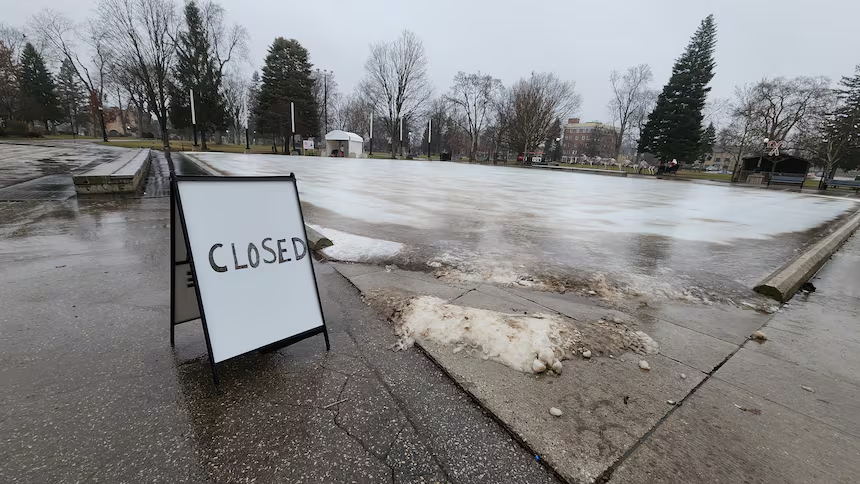
It will likely be a challenging winter for outdoor skating rinks as a super El Niño event is expected to bring warmer weather this season.
Robert McLeman, a professor of environmental studies at Wilfrid Laurier University, expects to see similar conditions to that of the 2015-2016 winter season when the last El Niño event happened.
“The temperatures went up and down there was a very late start to the winter, so it was a green Christmas and it didn’t really get cold until mid-January,” he told CBC News.
“That’s what I expect to happen again this winter. I do expect in the case of skating rinks, it’s going to be really frustrating for people within our area to build a good skating rink and then maintain it throughout the winter,” McLeman said.
El Niño is a natural climate pattern that can affect weather across the globe. It happens when ocean water in the central and eastern part of the Pacific Ocean becomes warmer than usual, according to Statistics Canada.
Forecasts earlier this year had called for one of the most powerful on record which is expected to peak some time in December.
McLeman also runs RinkWatch, a citizen science project that helps measure the effects of global warming on outdoor rinks. He says outdoor rinks need several days of consistent cold temperatures, ideally colder than -5 C, to have a solid base and allow the layers of water to freeze.
“You’re putting down thin layers of water and building it up in layers and it’s rare that the ground is perfectly levelled so to get a continuous surface, you need to do multiple floodings of the rink,” he said.
Fluctuating temperatures can cause the rinks to melt and they cause precipitation like freezing rain and wet snow.
“That’s really challenging for outdoor rink makers because it essentially ruins your smooth surface and you have to continually be rebuilding it,” McLeman explained.
‘We have to roll with the punches’
News of a warmer winter hasn’t stopped the City of Kitchener from preparing the outdoor rink at Victoria Park. During the fall, staff start to put up the boards of what will become two large ice pads, each measuring 80 feet by 170 feet, or 24 metres by 51 metres.
“Our preparation is still always the same, we want to make sure that if we do get those cold temperatures that we can take advantage of them,” Rob Jacob, assistant supervisor of horticulture told CBC News.
Jacob said they ideally need two weeks of consistent cold temperatures for the rinks as they’re made of a snow base that gets flooded 20 to 30 times. But he’s also realistic about the situation.

Rob Jacob is the assistant supervisor of horticulture with the City of Kitchener. He stands in front of what will become two large ice pads for people to skate on in the winter. (Carmen Groleau/CBC)
“We had an unseasonably warm fall time and even the forecast two weeks from now we have a couple of nights that are getting below and we’re expecting that until the new year,” he said, adding that ideal temperatures often don’t happen until January.
Jacob said if those ideal conditions present themselves, the city has the staff and equipment available to get the rinks ready quickly.
But if those conditions don’t happen consistently this winter, it means people will have to head to the outdoor rink at city hall.
“Part of being Canadian and this being an outdoor ice rink, we have to roll with the punches and we’ve been lucky these past couple of years that we’ve been able to have a rink for a couple of months. But unfortunately, if we don’t get that window we pack up and we hope for a colder winter next year,” he said.
Two photos, two very different winters. The top photo shows Feb. 20, 2024 in Kitchener’s Victoria Park. The bottom photo was taken on Feb. 20, 2025. (Kate Bueckert/CBC)
Warmer climate puts future of rinks at risk
Because there is a super El Niño impacting the weather this winter, McLeman said RinkWatch is hoping to recruit new participants to collect data that can be used to construct past and future skating seasons.
And the future looks challenging.
“What we can see for example, is that in the 2060s and 2070s, here in Waterloo region, it’s going to be really challenging to build outdoor skating rinks most winters, simply because our average temperatures are going to creep up to a point where we never really get those cold -5 C, -10 C days,” he said.
And that may have long-term impacts to our health and the future of winter sports, McLeman added.
“One thing I foresee in this warming climate that we have is with fewer outdoor rinks we will have lower participation in organized hockey and figure skating and that will have long-term consequences for amateur sports, professional sports, but also the fitness and well-being of our children,” he said.
